Germany vs Netherlands: Match Preview, Predictions and Betting Tips
Published on Saturday, 14 November 2026 by Steve


Germany vs Netherlands
UEFA Nations League Prediction & Betting Tips
Match Overview

Barcelona midfielder Frenkie de Jong out for weeks with serious right injury | Reuters
When Germany host the Netherlands at the Olympiastadion on Monday night, they do so knowing that anything less than victory will almost certainly end their UEFA Nations League campaign at the group stage. Jürgen Klopp's side sit third in League A Group 2 on five points from four matches, three behind both the Netherlands and Greece, with only the top two nations advancing to the quarter-finals. The equation is brutally simple: beat Oranje in Berlin and Germany keep their destiny in their own hands; fail to win, and a first Nations League campaign under the new Bundestrainer fizzles out before the knockout rounds. For a full slate of international fixtures this week, check our football predictions for today page, where every Nations League decider is covered in detail.
The two sides already met on Matchday 1 in Amsterdam, where Cody Gakpo's stoppage-time volley rescued a 1-1 draw for the Dutch and denied Klopp a winning start to his reign. Felix Nmecha had put Germany ahead early in that contest, but Germany's inability to close the game out set the tone for a frustrating group phase: one win (2-0 over Serbia), two draws and a shock 1-0 home defeat to Greece, followed by a goalless stalemate in Thessaloniki. Germany have scored just three goals in four Nations League matches — a strikingly low return for a squad boasting Florian Wirtz, Kai Havertz and Joshua Kimmich — and Klopp has responded by recalling 33-year-old Werder Bremen striker Niclas Füllkrug, who has nine Bundesliga goals in eight appearances this season. Reading the recent numbers through a proper football form guide lens makes one thing clear: Germany's process has been better than their results, but results are all that matter now.
The Netherlands, meanwhile, arrive in Berlin top of the group on goal difference, level with Greece on eight points. Xavi Hernández's 25-man squad for this decisive double-header was headlined by the return of Frenkie de Jong, back in Oranje colours for the first time since the World Cup after recovering from a knee injury, and the recall of Donyell Malen, who has eight goals in nine Serie A appearances for Roma. The Dutch will host Greece in Amsterdam on Friday 13 November before travelling to Berlin, and their Matchday 5 result will shape exactly what Xavi needs from the Olympiastadion. Germany must navigate the same knife-edge, away to Serbia in Belgrade three days earlier. With both coaches still in the early months of their tenures — Klopp appointed in July after Julian Nagelsmann's World Cup exit, Xavi in August after Ronald Koeman's departure — this is the first genuinely high-stakes appointment of two new eras. We see Germany's attacking depth, home advantage and desperation proving decisive in a 3-1 victory.
Tactical Preview

Germany's Wirtz eyes title and international recognition at World Cup | Reuters
Formation & Key Matchups
Germany 4-2-3-1
Klopp has trimmed his experimental 44-man pool down to a settled 24, and the tactical picture is finally coherent. Marc-André ter Stegen — now at Ajax — remains the undisputed No. 1, shielded by a back four of Philipp Treu, Jonathan Tah, Nico Schlotterbeck and Nathaniel Brown. The double pivot is where the identity is forged: captain Joshua Kimmich alongside Aleksandar Pavlović, with Bayern teenager Tom Bischof pressing for minutes after two excellent October displays. Ahead of them, Florian Wirtz operates as the creative hub from the left half-space, with Brajan Gruda — statistically Europe's most prolific dribbler this season — and Kai Havertz rotating around Niclas Füllkrug, whose penalty-box presence gives Germany a focal point they have sorely lacked. The full-backs will be instructed to push high, squeezing the Dutch build-up and funnelling play toward Wirtz between the lines. Understanding how Klopp's sides control a match through pressure and positioning is key to reading this fixture.
Netherlands 4-3-3
Xavi's Netherlands remain faithful to the possession-based principles of Dutch Total Football, but with a distinctly Barcelona-inflected flavour: short build-up, a holding midfielder dropping between the centre-backs, and wingers holding width. Bart Verbruggen starts in goal behind Denzel Dumfries, Virgil van Dijk, Micky van de Ven and Ian Maatsen. The midfield three picks itself when fit — Joey Veerman, the returning Frenkie de Jong and Tijjani Reijnders — a trio with more technical security than almost any midfield Germany will face this season. Up front, Cody Gakpo starts from the left, Donyell Malen from the right, with Brian Brobbey or Mexx Meerdink through the middle. The loss of Jeremie Frimpong and Nathan Aké strips Xavi of his usual right-sided rotation and left-back cover, meaning Dumfries must handle Wirtz and Brown largely on his own.
Critical Vulnerability
Both teams share the same weakness in mirror image: the space behind high full-backs. Germany's aggressive pushing of Treu and Brown leaves the channels in front of Tah and Schlotterbeck exposed — exactly where Gakpo and Malen attack on the counter, as Gakpo's equaliser in Amsterdam proved. Conversely, the Dutch high defensive line, missing Aké's recovery pace and without Frimpong's tracking, invites balls in behind for Füllkrug's diagonal runs and Wirtz's slide-rule passing. Whichever coaching staff fixes their transition defence first wins the tactical battle; on current form, Germany's bench depth in wide areas gives them the edge late in games.
Team News & Squad Status
Germany 🇩🇪
- Jamal Musiala (thigh) and Serge Gnabry (hamstring) are out injured — Klopp's two most experienced attacking midfielders both miss the camp.
- Waldemar Anton withdrew from the squad with muscular problems after the initial selection, leaving Jonathan Tah and Nico Schlotterbeck as the established centre-back pairing.
- Niclas Füllkrug returns to the national team for the first time since September 2025 after nine goals in eight Bundesliga games for Werder Bremen.
- 17-year-old Borussia Mönchengladbach attacking midfielder Wael Mohya received a surprise maiden call-up; he was left out of the Serbia matchday 23 but remains in the group for Berlin.
- Marc-André ter Stegen is confirmed as No. 1, ahead of Alexander Nübel (Beşiktaş) and Jonas Urbig, who kept clean sheets on his first two caps in October.
- Florian Wirtz is available and central to Klopp's plans; David Raum, Nick Woltemade, Karim Adeyemi, Deniz Undav and Yann-Aurel Bisseck were all omitted from the trimmed squad.
Netherlands 🇳🇱
- Frenkie de Jong returns after a knee injury suffered at the World Cup; he made his first Barcelona start of the season in late October and Xavi has already labelled him "underrated".
- Donyell Malen is back after a minor knee issue and brings eight goals in nine Serie A appearances for Roma.
- Ryan Gravenberch, Jeremie Frimpong, Jorrel Hato and Nathan Aké are all out injured — a heavy concentration of absences on the left and right defensive flanks.
- Veteran striker Wout Weghorst was omitted despite Xavi saying last month he remained under consideration.
- Youngsters Ruben van Bommel, Mexx Meerdink and Gjivai Zechiel retain their places after debuting in Xavi's first squad.
- Virgil van Dijk captains the side; Bart Verbruggen continues in goal with Mark Flekken and Robin Roefs as cover.
Predicted Lineups
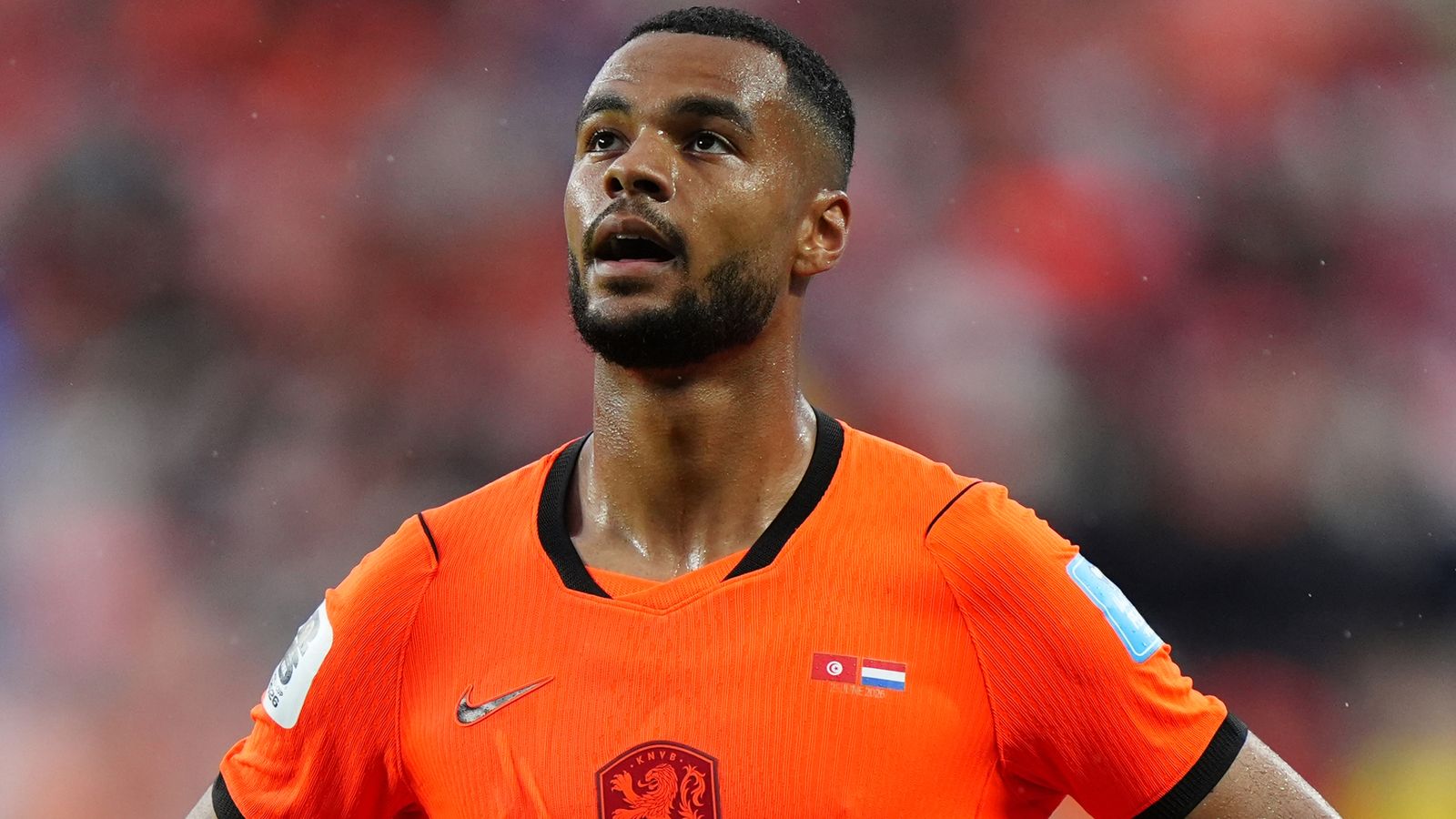
Cody Gakpo to stay with Netherlands squad at World Cup after loss of unborn son | Football News | Sky Sports
| Germany 4-2-3-1 | Netherlands 4-3-3 |
|---|---|
| Marc-André ter Stegen | Bart Verbruggen |
| Philipp Treu | Denzel Dumfries |
| Jonathan Tah | Virgil van Dijk (c) |
| Nico Schlotterbeck | Micky van de Ven |
| Nathaniel Brown | Ian Maatsen |
| Joshua Kimmich (c) | Joey Veerman |
| Aleksandar Pavlović | Frenkie de Jong |
| Brajan Gruda | Tijjani Reijnders |
| Florian Wirtz | Donyell Malen |
| Kai Havertz | Brian Brobbey |
| Niclas Füllkrug | Cody Gakpo |
Head-to-Head Record

Niclas Fullkrug is Germany's World Cup cult hero: This gap-toothed throwback of a striker carries a country's hopes now | Football News | Sky Sports
Germany and the Netherlands have met nine times since 2018, and the modern series is remarkably balanced — a sequence of high-scoring classics, dramatic comebacks and late twists that ranks among Europe's most compelling football rivalries. The Dutch won 3-0 in Amsterdam in October 2018 and 4-2 in Hamburg in September 2019, but Germany have been unbeaten in the four most recent meetings: a 2-1 friendly win in March 2024, a 2-2 draw and 1-0 Nations League victory in the autumn of 2024 (Jamie Leweling scoring the winner in Munich), and the 1-1 draw in Amsterdam on Matchday 1 of this campaign.
Across those nine meetings the goals have flowed at both ends: the Netherlands hold a narrow 16-14 aggregate edge, and six of the nine games have produced three or more goals. Six of the last seven meetings have seen both teams score, and the only clean sheet in the entire sequence came in Germany's 1-0 win in October 2024. Notably, the home side has won only three of the nine — this fixture has a habit of defying home comforts, though Germany did win the most recent Berlin-adjacent meeting in Munich. The psychological thread favors Germany slightly: they have lost none of the last four encounters, and the Dutch have never beaten a Klopp-coached Germany side.
Key Players Comparison
The Liverpool playmaker is the man who makes Germany's reduced squad purr. Operating between the lines or drifting left, Wirtz leads the team in chances created per 90 in this competition and scored crucial goals during the October window. With Musiala unavailable, every German attacking move runs through him.
Oranje's metronome returns at exactly the right moment. De Jong's ability to beat the first press and progress the ball through midfield is the single biggest tactical weapon Xavi possesses — and his duels with Kimmich and Pavlović will decide who controls territory in Berlin.
Nine goals in eight Bundesliga matches earned a recall that few predicted in the summer. At 33, Füllkrug offers what Havertz and Ebnoutalib cannot: elite penalty-box movement, aerial dominance and instinctive finishing against a Dutch back line missing both Aké and Hato.
The Liverpool forward already has one decisive contribution in this fixture — the stoppage-time equaliser in Amsterdam. Gakpo's knack for arriving late in the box and his chemistry with Van Dijk on set pieces make him the most likely Dutch scorer in Berlin.
The individual battle that excites most is Wirtz against de Jong — Germany's most creative player against the Netherlands' tempo-setter, a clash that echoes the great Klopp-era tactical duels defined by pressing versus possession. In the penalty areas, Füllkrug against Van Dijk is a heavyweight contest of contrasting styles: the Bremen striker's raw physicality and snap finishing against the Liverpool captain's positioning and leadership. Out wide, Gruda's dribbling against Dumfries — who must also contain Nathaniel Brown's overlaps — is a mismatch that could decide the flanks. Statistically, Germany's squad carries more goals per club minute this season, but the Dutch midfield trio of De Jong, Reijnders and Veerman has a higher combined pass-completion rate into the final third than any midfield Germany can field. It is, in short, Germany's firepower against Dutch control — and with both defences depleted, the star players on either side have every incentive to decide it themselves.
The Managers
Jürgen Klopp (Germany)
Appointed in July 2026 after Germany's World Cup round-of-32 exit to Paraguay ended Julian Nagelsmann's tenure, Klopp began with the boldest squad experiment in modern DFB history: a 44-man pool split across two camps in September and October, with 16 first-time call-ups. The results were mixed — five points from four games, three goals scored — but the audit identified the core he now trusts, trimmed to 24 names for November.
Klopp's messaging has shifted accordingly. "The experimentation is over; it is time to start winning meaningful games" has been the refrain of this camp, and the recall of Füllkrug alongside debuts for 17-year-old Mohya shows a coach balancing immediate results with long-term construction. A home defeat to Greece in September remains the only loss of his reign, and Klopp knows that Berlin is the first fixture where German football will truly judge him.
Xavi Hernández (Netherlands)
Xavi took over in August 2026 after Ronald Koeman stepped down following the Dutch World Cup exit to Morocco, becoming the first foreign-born coach to lead Oranje in the modern era. His start has been quietly excellent: eight points from four games, top of Group 2 on goal difference, with a clear stylistic identity installed in weeks rather than months.
Xavi's November squad selection underlined his authority: the returns of De Jong and Malen were balanced by the bold omission of record-chasing veteran Wout Weghorst and the continued trust in youthful debutants Van Bommel, Meerdink and Zechiel. "Frenkie is underrated — he makes everyone around him better," Xavi said this week, openly targeting a Nations League quarter-final in his first campaign. A result in Berlin would rubber-stamp the Xavi era; a defeat would hand the initiative to Greece and invite scrutiny of his away-game management.
Betting Predictions & Tips
Odds: 1.80
Everything about this fixture points to a motivated home favourite: Germany must win to keep their quarter-final hopes alive, the Olympiastadion crowd will be at full voice, and the Dutch arrive with a patched-up defence missing Aké, Hato and Frimpong. Germany are unbeaten in the last four meetings with Oranje and have won their previous home Nations League ties against top-tier opposition. For readers new to decimal pricing, our European 1X2 betting guide explains exactly how to evaluate a home favourite at 1.80. This is the anchor bet of the card.
Odds: 1.72
Six of the last seven H2H meetings have gone over 2.5, six of the last seven have seen both teams score, and both squads are missing first-choice defensive personnel. Germany need to force the game from minute one, the Netherlands counter-attack too well to stay quiet for 90 minutes, and the aggregate across the last nine H2H games is 30 goals. Our dedicated Over/Under prediction hub has tracked this market all campaign — the over has landed in 70% of Germany's and the Netherlands' Nations League matches combined this season. At 1.72, the price still undervalues the likely goal environment.
Odds: 1.65
Both teams have scored in every one of the last five H2H meetings, and neither defence arrives intact: Germany are without Anton and have an inexperienced full-back pairing in big-game terms, while the Dutch are without three defensive regulars. Ter Stegen has kept clean sheets against Serbia and Greece, but the Dutch attacking quartet of Gakpo, Malen, Brobbey and Reijnders is a significant step up in class. The GG/NG (both teams to score) tips page rates this among the strongest BTTS spots of the November window.
Odds: 11.00
Our model lands on a 3-1 home win: Germany's attacking depth overwhelms the depleted Dutch rearguard in the second half, but Oranje's midfield quality ensures they find the net at least once — just as they did in Amsterdam. A 3-1 home win also fits the historical pattern of Germany pulling away late in this fixture when playing at home. Correct score is a volatile market, so stake small; our correct score tips methodology covers how to price longshot scores properly.
Odds: 2.50
The story of the camp. Nine goals in eight Bundesliga games, a recall nobody predicted in June, and a matchup against a Dutch defence missing its two quickest recovery defenders. Füllkrug is expected to start as the central striker, and Germany's wide creators — Wirtz, Gruda, Havertz — are all at their best when supplying a penalty-box reference point. Anytime scorer odds of 2.50 on the division's most in-form German striker are generous; check our bet of the day page for how we size speculative plays like this one.
📊 Final Score Prediction
Match Analysis
We project a 3-1 Germany victory, and the path to it is coherent rather than hopeful. Germany's first task is territorial: with Kimmich and Pavlović double-pivoting against De Jong's dropping movements, the hosts must prevent the Dutch from settling into their passing rhythm the way Greece did in Augsburg and Thessaloniki. If Germany win the midfield battle — and their pressing intensity under Klopp suggests they will, particularly in a cauldron like the Olympiastadion — Wirtz and Gruda will find space against a Dutch midfield without Gravenberch's ball-winning cover. Füllkrug's movement against Van Dijk and Van de Ven is the tie-breaker: he does not need many chances, and Germany's creators are finally structured to supply him.
The Dutch will absolutely have their moments — De Jong and Reijnders are too good to be silenced for 90 minutes, and Gakpo has already punished this German side once this season. We expect Oranje to score, most likely from a transition or a set piece, and to keep the contest level deep into the second half. But Germany's bench — Bischof, Karl, Ebnoutalib, El Mala, Scherhant — offers a wave of fresh attacking legs that Xavi, missing Frimpong and Aké and already running a thin squad, cannot fully match. Our banker of the day panel lands on the same conclusion: a 2-1 or 3-1 home win is the most probable outcome band, and the extra goal comes from Germany's superior depth in the final half hour.
Key Insights & Statistics
- Germany must win to keep their quarter-final destiny in their own hands; they sit 3rd in Group 2 on 5 points, three behind the Netherlands and Greece.
- The Netherlands top the group on goal difference (8 points) but face Greece away in Amsterdam three days before Berlin — fatigue and rotation could matter.
- Jamal Musiala (thigh) and Serge Gnabry (hamstring) are Germany's only injury absentees; Florian Wirtz is fit and central to Klopp's plans.
- Frenkie de Jong returns for the Netherlands for the first time since the World Cup; Donyell Malen is back with 8 goals in 9 Serie A games for Roma.
- The Dutch are without Ryan Gravenberch, Jeremie Frimpong, Jorrel Hato and Nathan Aké — four defensive/midfield regulars.
- Niclas Füllkrug has been recalled after 9 goals in 8 Bundesliga appearances — his first Germany call-up since September 2025.
- Germany have scored only 3 goals in 4 Nations League games — the worst attacking return among the group's three contenders.
- Both teams have scored in each of the last 5 H2H meetings; 6 of the last 7 H2H games have produced over 2.5 goals.
- Germany are unbeaten in the last 4 meetings (W2 D2), including a 1-0 win the last time the sides met in Germany.
- 17-year-old Wael Mohya is the youngest player in Germany's squad and the only maiden call-up; Wout Weghorst was the notable Dutch omission.
- Germany's November squad averages 25.4 years — a deliberate blend after Klopp cut his experimental 44-man pool down to 24.
- The loser of this fixture is likely eliminated if Greece take points from their final two games — expect an open, aggressive contest rather than a cagey one.
Conclusion
Germany vs Netherlands in Berlin is the standout fixture of the November international window: two rebuilt giants, two iconic debutant-era coaches, and a place in the Nations League quarter-finals on the line. The historical record offers Germany genuine encouragement — unbeaten in the last four meetings, and victorious in the most recent home instalment — but history will count for little against a Dutch side that has been the group's most consistent performer under Xavi. What tips the scales for us is context: Germany's desperation, home advantage at a sold-out Olympiastadion, Füllkrug's remarkable recall, and a Dutch defensive unit missing four regulars across two crucial positions. If you are building a wider international card, pair this selection with options from our sure win predictions and double chance predictions pages to manage variance.
The counter-case is equally clear: if De Jong dictates midfield and Gakpo repeats his Amsterdam heroics, Germany's thin margin for error — no Musiala, no Gnabry, and a defence that leaked the group-worst soft goals in September — could see them eliminated on home soil. That is precisely why the market prices this as a genuine contest rather than a formality. But betting value lives in probability edges, and we assess Germany's true win probability closer to 58-60% than the 55-56% implied by 1.80, with the goal markets (over 2.5 and BTTS) offering secondary value given the H2H scoring pattern and both sides' defensive absences.
Final verdict: Germany 3-1 Netherlands. Expect the hosts to start fast, the Dutch to fight back through midfield class, and Germany's superior bench and set-piece threat to settle a classic in the final half hour. Back the home win at 1.80 as the primary play, over 2.5 goals at 1.72 for value, and keep a small-stake interest in the 3-1 correct score at 11.00 and a Füllkrug anytime goal at 2.50. Whatever happens in Berlin, this fixture rarely disappoints — and with both nations' knockout hopes on the line, Monday night promises another chapter in one of international football's greatest rivalries.


