Serbia vs Germany: Match Preview, Predictions and Betting Tips
Published on Wednesday, 11 November 2026 by Steve


Serbia vs Germany
UEFA Nations League Prediction & Betting Tips
Match Overview

Germany's Kai Havertz: 'I make runs that look pointless but I'm creating space' | Germany | The Guardian
Serbia host Germany at the iconic Stadion Rajko Mitić — the Marakana — on Friday 13 November 2026 in a UEFA Nations League League A Group A2 matchday five clash that means everything to the visitors and very little but pride to the hosts. Germany, sitting third in the group on five points, know that only a victory in Belgrade will keep their quarter-final ambitions alive, with the Netherlands and Greece both already on eight points. This fixture is one of the headline games on a packed Friday night card that also features Italy vs France, and you can find it alongside all the top fixtures in our daily football predictions hub. The reverse fixture at the Allianz Arena on 1 October ended 2-0 to Germany, Tom Bischof opening the scoring on 39 minutes and Florian Wirtz sealing Jürgen Klopp's first win as Bundestrainer on 61 minutes — but the scoreline flattered Serbia, who were pinned in their own half for virtually the entire evening.
For Serbia, this campaign has turned into a full-blown crisis. Veljko Paunović's Eagles have lost all four group matches — 1-2 to Greece, 1-2 to the Netherlands, 0-2 to Germany and 1-2 in Eindhoven — and sit bottom of Group A2 with zero points, three goals scored and eight conceded. Off the pitch, UEFA has sanctioned the Football Association of Serbia for the racist and discriminatory behaviour of supporters in the home games against Greece and the Netherlands, meaning this match will be played behind closed doors in a cavernous, silent Marakana. That removes the intimidating atmosphere that has historically made Belgrade such a difficult trip, and it strips Serbia of one of its few remaining advantages. The hosts have also lost Dušan Vlahović, who was recalled to the 27-man squad on 3 November only to withdraw again on 9 November citing a private situation, while first-choice centre-back Strahinja Pavlović is unlikely to feature due to a kidney problem and midfielders Nemanja Maksimović and Saša Lukić are both suspended.
Germany arrive in Belgrade under Jürgen Klopp knowing that nothing short of three points will do. The 2026 World Cup exit marked the end of an era, and Klopp's rebuild began with a chaotic 44-player experimental squad across his first two windows; for November he has cut that down to a decisive 24-man group, signalling that the experimentation phase is over and the results phase has begun. Germany's problem in this group has been bluntness rather than control — they have dominated possession in every match but scored just three goals in four outings — which explains the recall of 33-year-old Niclas Füllkrug, whose nine goals in eight Bundesliga appearances for Werder Bremen have forced Klopp's hand. For a full breakdown of how to weigh form trends like these, see our football form guide, and for background on the man tasked with restoring Germany's identity, our feature on Jürgen Klopp and his footballing philosophy is essential reading.
Tactical Preview

Mitrović named in provisional Serbia squad | NUFC
Formation & Key Matchups
Serbia 3-4-2-1
Paunović has largely settled on a back three in this campaign, with Nikola Milenković, Strahinja Eraković and Srđan Babić expected to line up in front of Vanja Milinković-Savić. The wing-back pair of Filip Kostić and Kosta Nedeljković must provide the width, while Sergej Milinković-Savić — one of the few Serbia players performing near his level — will anchor a depleted midfield shorn of the suspended Maksimović and Lukić, with Inter's Aleksandar Stanković likely to deputise. Captain Dušan Tadić, still the team's creative brain at 37, will float between the lines alongside Andrija Živković, feeding Aleksandar Mitrović, whose return from injury is the single biggest boost Serbia have had all autumn. Serbia's approach will be direct: isolate Mitrović against Germany's centre-backs, attack the channels behind the German full-backs, and lean on set pieces, where Milenković and Mitrović are both elite aerial targets.
Germany 4-2-3-1
Klopp has installed his trademark high-tempo, counter-pressing structure, with Marc-André ter Stegen confirmed as the undisputed number one behind a back four of Philipp Treu, Jonathan Tah, Nico Schlotterbeck and Maximilian Mittelstädt. Joshua Kimmich and Aleksandar Pavlović form the double pivot, a partnership Klopp has publicly defended despite growing debate about Kimmich's long-term role. The creative keys belong to Florian Wirtz, operating in the number ten space, with Tom Bischof — who scored his first international goal in the October meeting — and Said El Mala providing width and running. Kai Havertz is expected to lead the line, with the red-hot Füllkrug a devastating bench option if Serbia sit deep. Germany's positional play completely smothered Serbia in Munich (73.9% possession, 32 shots to Serbia's one, 28 chances created to one), and the tactical plan for Belgrade will be identical: control, pin, and probe. Our guide to controlling a match tactically maps out exactly the kind of territorial dominance Klopp is engineering.
Critical Vulnerability
Serbia's critical weakness is the space in wide areas behind their wing-backs, which Germany's inside forwards will attack ruthlessly — and with Pavlović likely out and both holding midfielders suspended, there is no screen in front of the back three. The counter-argument is Germany's own soft underbelly: away from home Klopp's side have produced only 1.00 goals per game (against 2.67 at home) and were beaten 1-0 by Greece in Augsburg. Without the injured Jamal Musiala and Serge Gnabry, Germany lack a second spontaneous creator behind Wirtz, meaning Serbia can load up on the Liverpool playmaker and look to spring Mitrović and the teenage revelation Mihajlo Cvetković — who scored in Eindhoven — into the channels on the break. If Serbia score first in this empty stadium, the psychological test for Klopp's young side would be severe.
Team News & Squad Status
Serbia 🔴🔴🔴🔴
- Dušan Vlahović (Beşiktaş) withdrew from the squad on 9 November due to a private situation, leaving Mitrović, Jović and 19-year-old Cvetković as the striking options.
- Strahinja Pavlović is unlikely to play after a kidney problem; Aleksa Terzić is also a doubt, leaving Milenković, Eraković and Babić as the likely back three.
- Nemanja Maksimović and Saša Lukić are both suspended, decimating the double pivot and forcing Paunović toward Aleksandar Stanković in midfield.
- Match played behind closed doors following UEFA sanctions for fan behaviour in the September home games against Greece and the Netherlands.
- Positive news: captain Dušan Tadić (115 caps) is fit, and record scorer Aleksandar Mitrović (64 international goals) returns after missing the October fixtures.
Germany 🟡🟢🟡🟡
- Jamal Musiala (thigh) and Serge Gnabry (hamstring) are out injured; Karim Adeyemi, David Raum, Nick Woltemade and Deniz Undav were omitted as Klopp cut his pool from 44 to 24 players.
- Niclas Füllkrug recalled for the first time since September 2025 after nine goals in eight Bundesliga games for Werder Bremen.
- 17-year-old Borussia Mönchengladbach prodigy Wael Mohya received a maiden senior call-up; Bayern's Lennart Karl (18) also included.
- Brajan Gruda (RB Leipzig) is a fitness doubt, having picked up a knock ahead of the window.
- Marc-André ter Stegen remains the clear number one, with Jonas Urbig — who kept clean sheets against Serbia and Greece in October — providing cover.
Predicted Lineups
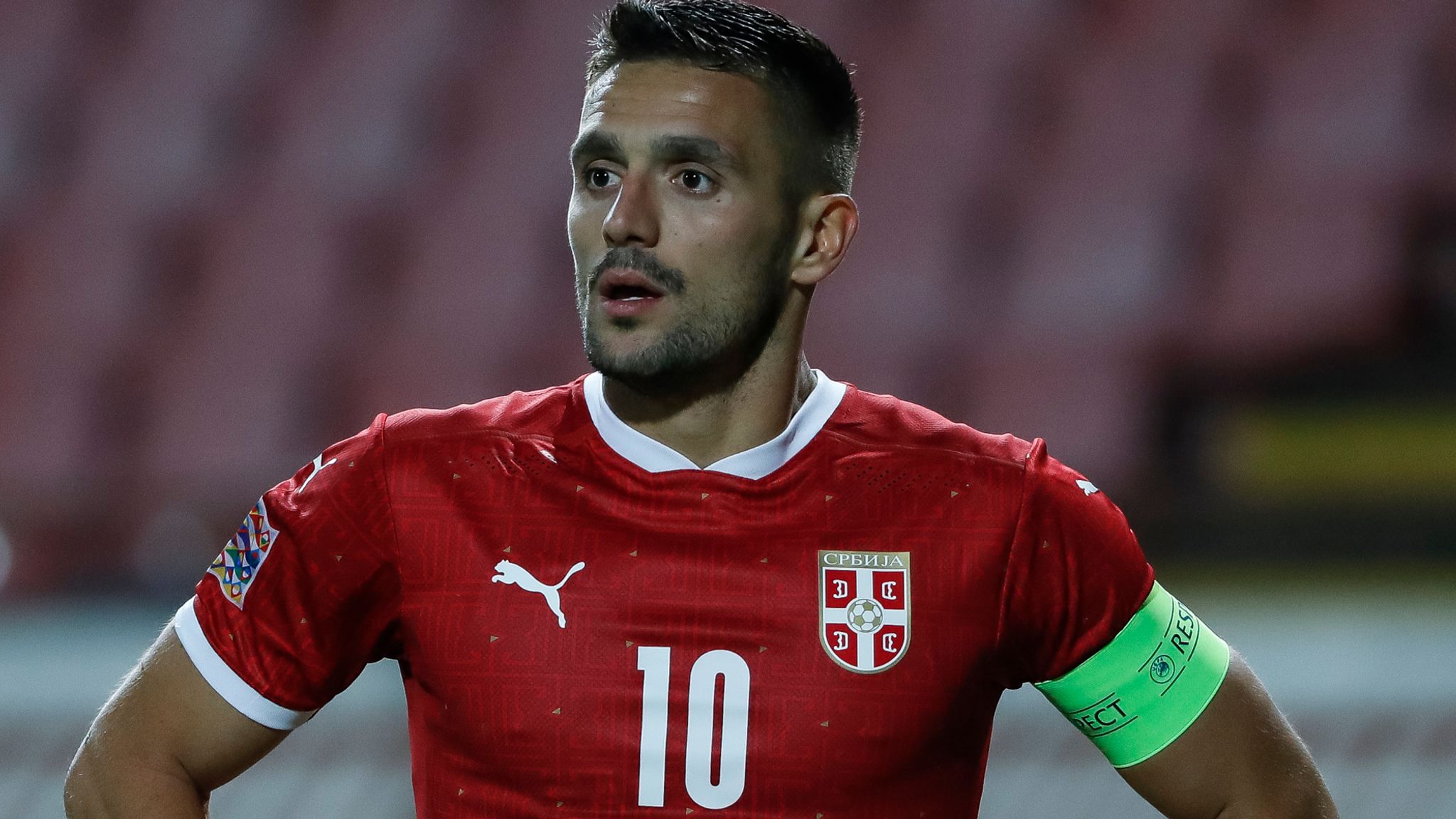
Serbia forward Dusan Tadic says his side's experience of qualifying for the last World Cup could be 'important' when they face Scotland on Thursday in the Euro 2020 play-offs.
| Serbia 3-4-2-1 | Germany 4-2-3-1 |
|---|---|
| Vanja Milinković-Savić (Napoli) | Marc-André ter Stegen (Ajax) |
| Milenković – Eraković – Babić | Treu – Tah – Schlotterbeck – Mittelstädt |
| Kostić – S. Milinković-Savić – A. Stanković – Nedeljković | Kimmich – Pavlović |
| Tadić – Živković | Bischof – Wirtz – El Mala |
| A. Mitrović | Havertz |
Head-to-Head Record

Germany's Wirtz eyes title and international recognition at World Cup | Reuters
These nations have met only four times since Serbia became an independent footballing nation, and the series is far more balanced than the respective FIFA rankings — Germany 12th, Serbia 44th — would suggest. The first meeting was a friendly in Gelsenkirchen on 31 May 2008, when Germany edged it 2-1 through late strikes from Oliver Neuville (74') and Michael Ballack (82') after Boško Janković had given Serbia a shock lead. Serbia's finest hour in the fixture came at the 2010 FIFA World Cup in South Africa, where Milan Jovanović's goal earned a famous 1-0 group-stage win over Joachim Löw's side. The teams then shared a 1-1 draw in a Wolfsburg friendly in March 2019 — Luka Jović opening the scoring before Leon Goretzka levelled — before Germany's 2-0 triumph in Munich six weeks ago completed the quartet.
The underlying numbers from the October meeting tell the real story of the current gap between these sides: Germany controlled 73.9% of possession, out-shot Serbia 32-1, created 28 chances to Serbia's one, and completed 675 passes at 91.3% accuracy — figures that explain why the betting market prices Germany as heavy favourites even on the road. For punters who like wider matchday context beyond this tie — including how other League A contenders are faring on the same night — our England vs Croatia preview covers another of Friday's marquee Nations League fixtures.
Key Players Comparison
Liverpool's superstar creator scored the second goal in the October meeting and has become the undisputed focal point of Klopp's attack with Musiala injured. Serbia have no natural answer to his half-space drifting.
Serbia's record scorer with 64 international goals returns from injury at the perfect time. With Vlahović out, everything — long balls, crosses, set pieces — will funnel through him.
The Arsenal forward is expected to lead the line, offering movement in behind that complements Wirtz's creativity. Bookmakers price him among the most likely scorers on the night.
At 37 and with 115 caps, the captain remains Serbia's metronome. If Serbia are to spring a surprise, Tadić's service into Mitrović will be the delivery mechanism.
The individual duel that will shape this match is Wirtz versus Serbia's makeshift screen. With Maksimović and Lukić suspended, the screening duty in front of the back three falls to players who are not natural destroyers, and Wirtz's ability to receive on the half-turn between the lines — drawing fouls and sliding runners in behind — was the defining feature of the Munich game. Serbia's best route to goal is almost certainly set pieces: Germany have conceded from dead-ball situations in recent windows, and a Milenković or Mitrović header against the run of play is the scenario Paunović will have drilled all week. It is worth noting that Serbia, despite losing all four group games, have scored in three of them — this is not a side that goes quietly, and that scoring habit feeds directly into the goal markets discussed below. For more on how star availability swings matches, our recent form analysis guide covers the key predictive indicators.
The Managers
Veljko Paunović
Paunović took over the Serbia job in 2025 with a brief to modernise the Eagles after Dragan Stojković's long reign, but the 2026–27 Nations League campaign has been the toughest stretch of his tenure. Four defeats from four have left Serbia bottom of Group A2 and facing relegation to League B, and the off-field disciplinary scandal that has cost the team its home support has only compounded the pressure.
Still, Paunović's reputation for developing young players — shown by the integration of Anderlecht's Mihajlo Cvetković and Inter's Aleksandar Stanković — gives him a longer leash with the FSS. His challenge on Friday is tactical damage limitation without his first-choice centre-back, both holding midfielders, or his second striker, while keeping a proud fanbase — watching from afar — convinced the project is intact.
Jürgen Klopp
Klopp's appointment as Bundestrainer was the biggest managerial story of the post-World Cup cycle, and the early months have followed the expected script: thrilling structural improvement married to frustrating results. Germany have controlled every game under him — including the 2-0 defeat of Serbia that delivered his first win — but the bluntness in front of goal (three goals in four Nations League matches) has drawn criticism.
The decision to slash his squad from 44 to 24 players for this window was a statement of intent: the identity-building phase is complete, and now the winning must start. Klopp's sides have historically taken time to click in tournament settings, but he knows that back-to-back wins in Belgrade and against the Netherlands would silence every doubler and turn a stuttering campaign into a quarter-final place. The psychological dimension of coaching a young group through a must-win away fixture is precisely the territory our profile of Klopp's methods explores in depth.
Betting Predictions & Tips
Odds: 1.40
Everything points one way: Germany dominated the reverse fixture to an almost comical degree (32 shots to one), Serbia are missing half of their spine, playing behind closed doors, and have lost all four group games. Germany must win to keep their quarter-final hopes alive, while Serbia have nothing but pride to play for. This is as close to a banker of the day as the November international window offers, and it anchors our 1X2 betting analysis approach — full staking logic is explained in that guide.
Odds: 1.80
The bare 1.40 on the away win understates the likely margin. Serbia have conceded 2.83 goals per away game in this campaign, were beaten 2-0 at home by this same German side in all but name, and now field a patched-up midfield and defence. Germany's expected dominance in possession should translate into a multi-goal win, and our draw no bet and handicap frameworks both support covering the spread. See also our over/under prediction hub for the goals markets.
Odds: 1.95
Serbia's matches have been relentlessly high-scoring: all of their last five internationals have gone over 2.5 goals, and they have scored in three of their four Nations League defeats. Germany, with Wirtz pulling strings and Füllkrug arriving as an impact substitute, carry far more goal threat than their three-goals-in-four-games group tally suggests. Our BTTS and goals hub covers the logic behind totals betting in fixtures exactly like this one.
Odds: 2.25
Wirtz scored the killer second goal in the October meeting and is Germany's designated penalty-area threat from the number ten position. Against a Serbia midfield missing both destroyers, he will spend the evening arriving at the edge of the box unopposed. With Musiala and Gnabry absent, the creative and scoring burden lands squarely on his shoulders — and he has thrived under that weight at Liverpool.
Odds: 13.00
Our headline prediction is a 1-3 away win: Germany's territorial control and superior depth should produce three goals, while Serbia's set-piece threat — Milenković and Mitrović against a German defence that has conceded from dead balls — earns the hosts a consolation in an empty stadium. Small stakes only, but the price fairly reflects the game script. For more scoreline methodology, visit our correct score tips page.
📊 Final Score Prediction
Match Analysis
We expect Germany to win 3-1. The pattern of the October meeting — near-total German control against a Serbia side that could not get out — should repeat in an eerily quiet Marakana, and Serbia's absentee list has only grown since. The visitors' superior pressing, Wirtz's creativity between the lines and the depth of attacking options — Havertz starting, Füllkrug and Ebnoutalib in reserve — give Klopp multiple routes to three goals against a defence missing its leader. Germany's one vulnerability, an occasional softness from set pieces and in transition, is precisely where Serbia's remaining quality lives: expect Mitrović or Milenković to convert one dead-ball or second-ball situation to give the scoreline a respectable look for the hosts.
Crucially, the context demands a full-throttle German performance: with the Netherlands and Greece on eight points, Klopp's side must win in Belgrade to take their quarter-final destiny to the final matchday against the Dutch in Berlin. A young German team playing a liberated, empty-stadium away fixture, against opponents with nothing left to protect and a depleted spine, is a recipe for an open, high-scoring away win. Serbia will compete for spells, and may even land the first blow — but over ninety minutes, class and necessity should combine for a 1-3 Germany victory.
Key Insights & Statistics
- Serbia have lost all four Nations League group games (1-2, 1-2, 0-2, 1-2) and sit bottom of Group A2 with zero points and a -5 goal difference.
- The match is played behind closed doors after UEFA sanctioned Serbia for racist and discriminatory fan behaviour in the September home fixtures.
- Germany dominated the reverse fixture 2-0 with 73.9% possession, a 32-1 shot count and 28 chances created to Serbia's one.
- Serbia have scored in three of their four group defeats — including through Luka Jović against the Netherlands and 19-year-old Mihajlo Cvetković in Eindhoven.
- Germany have scored only three goals in four Nations League matches — the fewest in League A among unbeaten-on-possession sides — prompting Füllkrug's recall (9 goals in 8 Bundesliga games).
- Aleksandar Mitrović, Serbia's record scorer with 64 goals, returns; Dušan Vlahović withdrew on 9 November for personal reasons.
- Nemanja Maksimović and Saša Lukić are both suspended, while Strahinja Pavlović (kidney problem) is unlikely to feature for Serbia.
- Germany are missing Jamal Musiala (thigh) and Serge Gnabry (hamstring); Klopp cut his squad from 44 players to 24 for this window.
- Serbia's only win in four meetings with Germany came at the 2010 World Cup (1-0); Germany have won the other two competitive-adjacent meetings and a 2008 friendly.
- Germany must win to keep quarter-final hopes alive; defeat or a draw leaves them depending on other results with the Netherlands visiting Berlin three days later.
- For context on what a result like this means for a keeper's ledger, see our piece on what a clean sheet means in football — Jonas Urbig kept two in October.
- Serbian club football context: the domestic game remains a talent conveyor belt, as seen in our Javor vs TSC preview from the Serbian second tier.
Conclusion
Serbia vs Germany is a fixture of starkly contrasting missions. Germany arrive in Belgrade with their entire Nations League campaign on the line: win, and the quarter-final dream rolls on to a Berlin showdown with the Netherlands; drop points, and the early Klopp era faces its first genuine inquest. Everything in the data — the 32-1 shot dominance of the reverse fixture, Serbia's four defeats from four, a depleted Serbian spine, and an empty stadium stripped of its famous hostility — points to the visitors.
Serbia's hope rests on pride, Mitrović's aerial supremacy, Tadić's artistry and the possibility that Germany's youthful away form wobbles again. The Eagles have scored in three of their four defeats, and an early set-piece goal could turn this into a far nervier evening than the odds suggest. But over ninety minutes, the gulf in depth, structure and motivation should tell: Klopp's narrowed 24-man group was assembled precisely for nights like this.
Our prediction is a 1-3 Germany win — an away victory, over 2.5 goals, and Florian Wirtz among the scorers all feature in our recommended tips above. Expect Germany to control the game from the first whistle, survive a brief Serbian rally, and pull away in the second half as the hosts' patched-up midfield tires. For all of this weekend's international action, keep our football predictions hub bookmarked, and wager only what you can afford to lose.


